

Viscose jacquard scarves combine the soft hand feel of viscose-based fabrics with patterns created through jacquard weaving. For scarf brands, retailers, and wholesalers, these products offer opportunities to develop textured designs for men's and women's accessory collections.
However, selecting a suitable viscose jacquard scarf involves more than choosing an attractive pattern. Fabric composition, yarn structure, weaving density, weight, fringe finishing, and dimensional stability all influence the final product.
For buyers developing private-label scarf collections, understanding these factors helps establish clearer product specifications, compare suppliers, and reduce quality risks before bulk production.
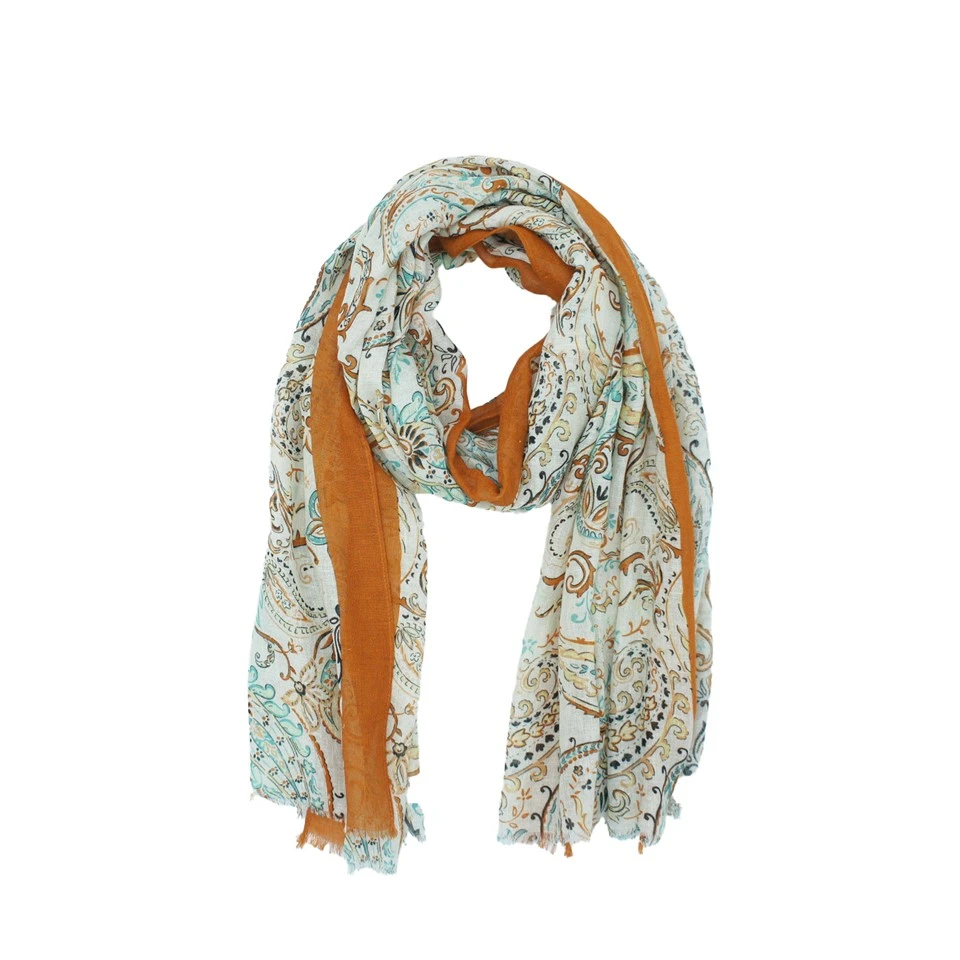
Understanding Viscose and Viscose-Blend Fabrics
Viscose is a regenerated cellulose fiber commonly used in scarves because of its soft touch, smooth surface, and fluid drape. It can be woven into different fabric structures and combined with other fibers to achieve specific product characteristics.
For jacquard scarves, the choice between 100% viscose and viscose-blend yarns should depend on the intended appearance, hand feel, durability, and target price.
100% Viscose
100% viscose scarves are often selected for their smooth surface, soft feel, and flowing drape. The material can support detailed woven patterns and is suitable for lightweight and medium-weight scarf designs.
Buyers should also consider its sensitivity to moisture and care conditions. Dimensional stability, shrinkage, and color performance should be evaluated through product testing rather than assumed from fiber composition alone.
Viscose-Blend Fabrics
Blending viscose with other fibers changes the fabric's overall performance.
| Fiber Blend | Potential Fabric Characteristics | Buyer Considerations |
|---|---|---|
| Viscose and Polyester | Can improve shape retention and dimensional stability | Check softness, static behavior, and surface appearance |
| Viscose and Cotton | Combines a smooth hand feel with a more natural cotton texture | Evaluate fabric weight and shrinkage |
| Viscose and Wool | Can provide a warmer feel and a more textured appearance | Check fiber ratio, softness, and pilling |
| Viscose and Acrylic | Offers additional options for texture and fabric construction | Evaluate hand feel, pilling, and durability |
The actual performance depends on fiber ratios, yarn specifications, and weaving construction. Buyers should request the exact composition rather than relying on general descriptions such as viscose blend.
How Jacquard Weaving Creates Scarf Patterns
Jacquard is a weaving technique that controls individual warp yarns to create patterns within the fabric structure. Unlike printed designs, jacquard patterns are formed during weaving through the arrangement of warp and weft yarns.
This allows patterns to become part of the woven fabric rather than simply being applied to its surface.
Jacquard vs. Printed Scarves
Understanding the difference helps buyers select the appropriate production method for their collections.
| Comparison | Jacquard Scarves | Printed Scarves |
|---|---|---|
| Pattern Formation | Created through woven structures | Applied through printing |
| Surface Appearance | Can show woven texture and pattern relief | Depends on printing method and fabric surface |
| Pattern Details | Suitable for structured woven motifs | Suitable for detailed colors and graphic artwork |
| Color Development | Depends on yarn colors and weaving design | Depends on printing inks and processes |
| Design Development | Requires weaving pattern preparation | Requires print artwork and color development |
Neither technique is universally better. Jacquard is suitable when the collection requires woven textures and integrated patterns, while printing can be more appropriate for complex illustrations and photographic-style designs.
What to Consider When Developing Jacquard Patterns
Before production, buyers should confirm:
Pattern repeat: The size and arrangement of repeating motifs.
Weave structure: How the pattern is formed through warp and weft.
Color arrangement: The number of yarn colors and their distribution.
Pattern scale: Whether the design suits the scarf dimensions.
Fabric balance: Whether the pattern affects thickness, flexibility, or drape.
A weaving sample is useful for evaluating the actual appearance because digital artwork alone cannot fully represent the final woven structure.
Key Quality Factors in Viscose Jacquard Scarves
For bulk buyers, a scarf's appearance is only one part of product evaluation. Fabric performance and finishing consistency also influence customer satisfaction and product returns.
Fabric Softness and Drape
A soft hand feel is particularly important for scarves worn close to the neck. Buyers should evaluate surface smoothness, flexibility, and how naturally the fabric falls when worn.
The fiber composition, yarn characteristics, fabric density, and finishing process can all affect the result.
Fabric Weight and Thickness
Fabric weight, commonly expressed in grams per square meter (GSM), helps buyers compare different material constructions.
A lightweight structure may provide a more fluid drape, while a heavier construction may create a fuller appearance and more substantial hand feel.
There is no universal ideal GSM for viscose jacquard scarves. The appropriate weight should be determined according to the target season, scarf dimensions, yarn specifications, and intended wearing experience.
Weaving Density and Pattern Definition
Weaving density influences fabric coverage, texture, and the visibility of jacquard patterns.
Buyers should inspect whether the pattern is clearly defined, whether the fabric surface is consistent, and whether there are visible weaving defects such as loose yarns or irregular areas.
Dimensional Stability and Color Fastness
Viscose-based fabrics require attention to shrinkage and dimensional changes during care and use.
For bulk orders, buyers should establish acceptable testing requirements for:
- Dimensional stability after washing or care treatment.
- Color fastness to washing and rubbing, where applicable.
- Pilling and surface abrasion resistance.
- Consistency of fabric appearance between production batches.
Testing methods and acceptance levels should be agreed upon before bulk production, based on the product's intended use and target market.
Design Details: Fringe Finishing and Men's and Women's Styles
Fringe finishing and overall styling influence the appearance of a jacquard scarf. These details should be included in the product specification rather than treated as minor decorative decisions.
Short Fringe Finishing
Short fringes create a neat and relatively understated edge finish, making them suitable for both classic and contemporary scarf designs.
When evaluating fringe quality, buyers should consider:
- Fringe length and consistency.
- Even distribution along the scarf edge.
- Secure yarn construction to reduce unwanted unraveling.
- Clean finishing at the transition between the woven body and fringe.
- Consistency across different pieces.
The fringe length should be confirmed through a physical sample, as the final appearance can vary depending on yarn thickness and edge construction.
Men's Jacquard Scarves
Men's collections often include geometric motifs, understated patterns, and coordinated color combinations.
For buyers developing men's accessory lines, useful considerations include:
- Balanced pattern proportions.
- Neutral and versatile color combinations.
- Suitable dimensions for different wearing styles.
- A fabric weight that matches the intended seasonal positioning.
- Clean and restrained fringe finishing.
Women's Jacquard Scarves
Women's collections may include floral motifs, decorative geometric patterns, and more varied color combinations.
Buyers can explore:
- Larger or smaller repeating patterns.
- Multiple yarn-color combinations.
- Different scarf dimensions.
- Soft fabric structures with fluid drape.
- Coordinated labels and packaging for retail collections.
These are design directions rather than fixed rules. The final specification should reflect the brand's target customers and collection positioning.
Customization Options for Jacquard Scarf Collections
For private-label projects, customization should cover the complete product specification, from fabric selection to retail presentation.
| Customization Area | Available Development Options |
|---|---|
| Fabric Composition | 100% viscose or selected viscose blends |
| Pattern Design | Geometric, floral, abstract, or brand-specific motifs |
| Colors | Custom yarn colors and coordinated color combinations |
| Dimensions | Customized length and width |
| Fabric Weight | Weight and thickness adjusted to product requirements |
| Fringe Details | Customized fringe length and finishing |
| Branding | Woven labels, sewn labels, and brand identification |
| Packaging | Individual bags, paper bands, labels, and customized packaging |
For jacquard development, pattern complexity, yarn selection, and color arrangements can influence sampling requirements and production costs.
Buyers should provide reference images, artwork, target dimensions, and preferred material compositions whenever possible. These details help suppliers assess feasibility and prepare more accurate samples and quotations.
What Buyers Should Confirm Before Placing a Bulk Order
A clear purchasing specification helps reduce misunderstandings between buyers and suppliers.
Before approving a bulk order, buyers should confirm the following points.
Product Specifications
Confirm the fiber composition, dimensions, fabric weight, weaving structure, pattern colors, and fringe details.
All specifications should correspond to the approved sample.
Sample Evaluation
A physical sample allows buyers to assess hand feel, drape, pattern definition, color appearance, and finishing quality.
For customized jacquard designs, buyers should also review the actual woven pattern rather than approving the project based only on digital artwork.
MOQ and Pricing Structure
Minimum order quantities may vary according to fabric construction, yarn sourcing, pattern complexity, and production arrangements.
When developing multiple designs and colors, buyers should request separate MOQ information for each design and color.
Quotations should clearly identify the specifications included in the price, such as material composition, dimensions, weight, labeling, and packaging.
Production Lead Time and Quality Control
Buyers should distinguish between sample development time and bulk production time.
The production schedule should account for material preparation, pattern development where necessary, sampling approval, bulk weaving, finishing, inspection, and packing.
Quality requirements should be established before production, with particular attention to material consistency, pattern accuracy, fringe finishing, and dimensional measurements.
How XingHeMei Supports Custom Scarf Development
XingHeMei works with scarf production partners in Zhejiang and Jiangsu, supporting overseas brands, retailers, and wholesalers with product sourcing, sampling coordination, production follow-up, quality inspection, packing, and export coordination.
With over 10 years of experience in scarf sourcing and export operations, our team helps buyers coordinate different stages of customized scarf projects.
For viscose and viscose-blend scarf development, our support includes:
Material Sourcing: Coordinating suitable fabric and fiber options according to project requirements.
Product Development: Supporting pattern, color, size, and design discussions.
Sample Follow-Up: Coordinating sample development and reviewing product details against buyer specifications.
Production Coordination: Following up on production progress and communicating project requirements with partner factories.
Quality Inspection: Coordinating quality checks for product specifications, appearance, and finishing.
Branding and Packing: Supporting customized labels, packaging, and export arrangements.
For jacquard scarf projects, weaving capability and pattern feasibility are assessed according to the selected production partner and product specifications before sampling is confirmed.
Rather than offering a standard product without considering the collection requirements, XingHeMei helps buyers coordinate product details and sourcing arrangements around their intended market and brand positioning.
Frequently Asked Questions About Viscose Jacquard Scarves
Q: Are Viscose Jacquard Scarves Soft?
A: Viscose is commonly selected for its smooth surface and soft hand feel. However, the final softness also depends on yarn characteristics, weaving density, fabric construction, and finishing.
Q: What Is The Difference Between Viscose Jacquard And Printed Viscose Scarves?
A: Jacquard patterns are created through weaving structures, while printed patterns are applied to the fabric surface. Jacquard provides woven pattern textures, whereas printing offers flexibility for detailed graphic designs.
Q: Can Viscose Jacquard Scarves Be Customized For Private-Label Brands?
A: Yes. Custom development can include fiber composition, woven patterns, yarn colors, dimensions, fringe finishing, brand labels, and packaging. Production feasibility depends on the selected weaving resources and specifications.
Q: What Affects The MOQ Of Custom Jacquard Scarves?
A: MOQ can depend on yarn availability, fabric construction, pattern complexity, color arrangements, and production requirements. Buyers should request MOQ details for each design and color.
Q: What Should Buyers Check When Evaluating Jacquard Scarf Samples?
A: Important evaluation points include fiber composition, fabric weight, softness, drape, pattern definition, color consistency, dimensions, fringe finishing, and dimensional stability.
Q: How Long Does Custom Jacquard Scarf Production Take?
A: The lead time depends on material availability, pattern development, sample approval, order quantity, and production scheduling. Buyers should request separate sample and bulk production schedules before confirming an order.
Conclusion
Choosing viscose jacquard scarves for a retail or private-label collection requires careful consideration of material composition, weaving construction, pattern development, fabric performance, and finishing details.
For brands and wholesalers, a clearly defined product specification and an approved physical sample provide a stronger foundation for consistent bulk production.
XingHeMei supports overseas buyers through scarf sourcing, product development coordination, sampling, production follow-up, quality inspection, and customized packing and export services. By coordinating these stages with suitable production partners, we help buyers develop scarf collections that align with their product requirements and brand positioning.