

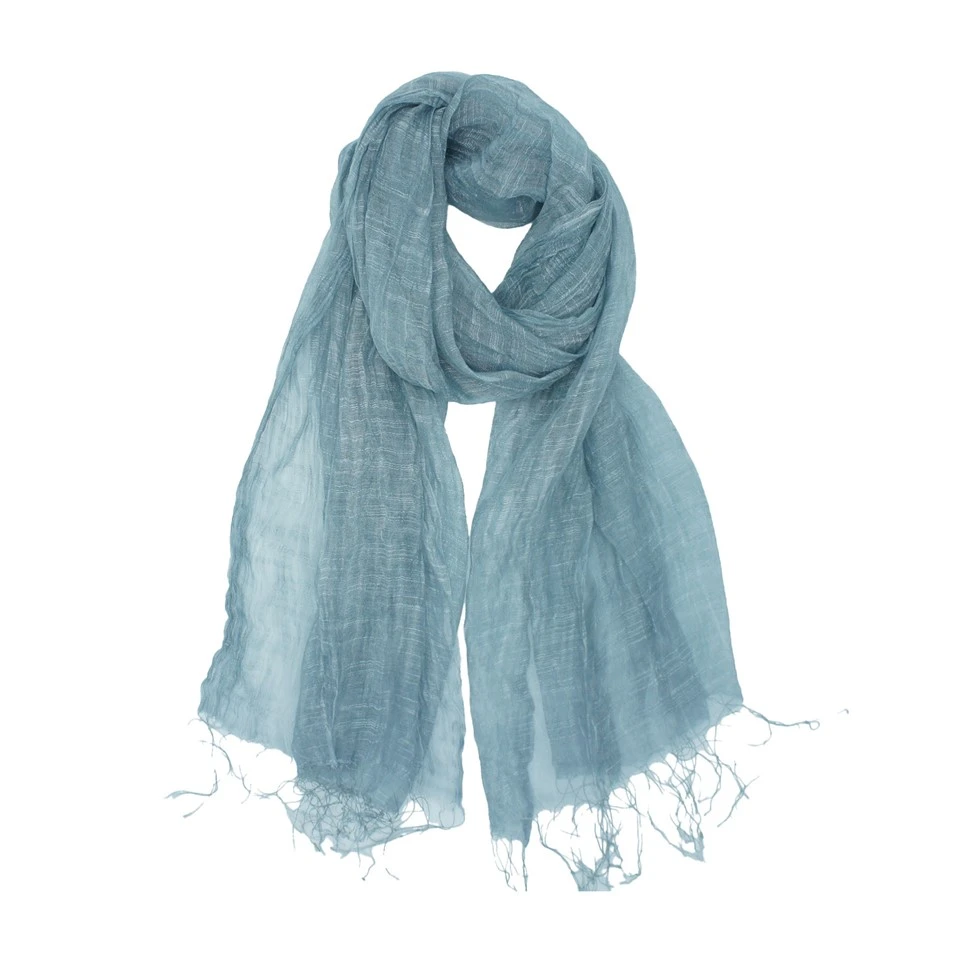
Fiber Interaction System
This product is defined by how three fibers interact inside one fabric system:
Silk filament layer
Silk contributes low-twist filament sections that form a smooth surface interface, reducing rough tactile resistance during contact with skin.
Cotton fiber matrix
Cotton fibers occupy intermediate yarn positions and absorb moisture during wearing conditions, stabilizing humidity exchange between fabric and environment.
Linen reinforcement structure
Linen fibers introduce higher stiffness zones inside the weave, increasing dimensional stability and reducing deformation under repeated folding cycles.
The final fabric behavior is a balanced fiber interaction network rather than a single-material system.


Solid Dyeing Architecture
Solid color is not treated as surface decoration but as a controlled dye penetration process.
Production control steps:
- fiber pre-treatment to equalize absorption rate
- dye bath temperature stabilization during coloration
- controlled penetration time for multi-fiber absorption balance
- post-dye washing to remove unbonded pigment residues
This ensures color distribution remains uniform across silk, cotton, and linen fibers with different absorption characteristics.
Mechanical Behavior Under Daily Use Conditions
The scarf is designed for textile-level mechanical exposure such as folding, twisting, and carrying inside bags.
Observed behavior under use conditions:
- silk fibers maintain surface smoothness under bending cycles
- cotton fibers absorb micro-tension to reduce fabric stress concentration
- linen fibers limit long-axis elongation during repeated folding
The fabric responds to mechanical load through distributed stress absorption instead of single-point deformation.


Weaving Structure and Fabric Formation
The base fabric is constructed using a controlled woven system:
warp direction:
mixed fiber yarn alignment for structural support
01
weft direction:
cotton-dominant yarn distribution for stability
02
weave type:
plain or light twill structure depending on order specification
03
surface formation:
natural matte texture without synthetic coating layer
04
This structure produces a non-uniform natural textile surface suitable for solid color presentation.
Production Stability in Batch Manufacturing
Batch stability is controlled through measurable production parameters:
- yarn blending ratio control before weaving
- dye absorption calibration per fiber type
- fabric tension control during finishing stage
- dimensional stabilization during post-washing and drying
The system is designed to reduce variation between production batches in both color depth and fabric thickness.

Integration into Supply Chain Programs
This scarf is used as a base material in structured procurement systems:
seasonal apparel accessory sourcing programs
brand foundation SKU development (solid color series)
multi-color catalog expansion systems
uniform accessory programs for retail chains
promotional textile supply orders
The product functions as a baseline SKU platform for color-driven product expansion.

Custom Development Parameters
Customization is defined at system level rather than surface level:
- Fiber ratio adjustment (silk/cotton/linen proportion)
- Yarn thickness modification for seasonal weight
- Dye system adjustment for brand-specific standards
- Edge finishing (rolled/machine hem/raw edge)
- Labeling integration at production stage
Customization is applied before weaving and dyeing, not after finishing.
Inquiry Entry Process
Bulk stage begins only after sample approval.
Supplier System – XingHeMei Manufacturing Framework
Hangzhou XingHeMei operates a textile supply system that integrates:
fiber sourcing coordination
weaving control management
dye system calibration
cutting and finishing control
export packaging preparation
The system is designed for repeatable production of solid-color textile SKUs.
Hot Tags: silk cotton linen mixed solid scarf, China silk cotton linen mixed solid scarf suppliers, manufacturers, factory


